Process Mining

Discover and optimize business processes with AI

What is IBM Process Mining?

IBM describes Process Mining as an AI-powered method to discover how processes actually run based on event data from enterprise systems. It helps identify bottlenecks, variants, compliance gaps, and automation opportunities.

  • Data foundation: event logs from ERP, CRM, ITSM and other operational systems.
  • Operational view: process maps based on real execution paths, not workshop assumptions.
  • Action layer: monitoring, conformance checks, and identification of automation candidates.

Data proofs from IBM materials

176%

Up to 176% ROI over 3 years (Forrester TEI study commissioned by IBM).

$1.52M

Potential total benefits PV over 3 years in the same TEI benchmark.

30-70%

Typical reduction in time spent on process mapping, analysis, and optimization.

+20% / >70%

BBVA Argentina case (IBM): +20% transaction processing capacity and over 70% faster transaction execution.

Sources (IBM): Product page, BBVA Argentina case study.
Process Optimization

Transform your business by leveraging Process Mining to gain a comprehensive, data-driven view of your operations.

End-to-End Visibility

Delegate repetitive tasks to always-on bots, freeing employees to concentrate on strategic initiatives and drive innovation.

Simulation & ROI

Realize cost efficiencies by automating routine manual tasks, enabling employees to focus on revenue-generating activities.

Process & Task Mining

Rapidly create, test, and deploy new automation workflows in hours, not months, for an immediate impact.

Automation Integration

Execute tasks in seconds or minutes, 24/7, to maximize output without adding extra resources.

Automation at Scale

  • Generate RPA bot frameworks from task mining insights.
  • Support DMN and BPMN to scale automation seamlessly across your organization.
  • Operational Excellence: Detect issues, alert teams to high-priority tasks, and streamline workflows through automation, empowering your team with proactive insights for sustained efficiency and growth.

How Process Mining Works in Logistics

Expandable guide with practical examples: from process discovery and root-cause analysis to automation decisions.

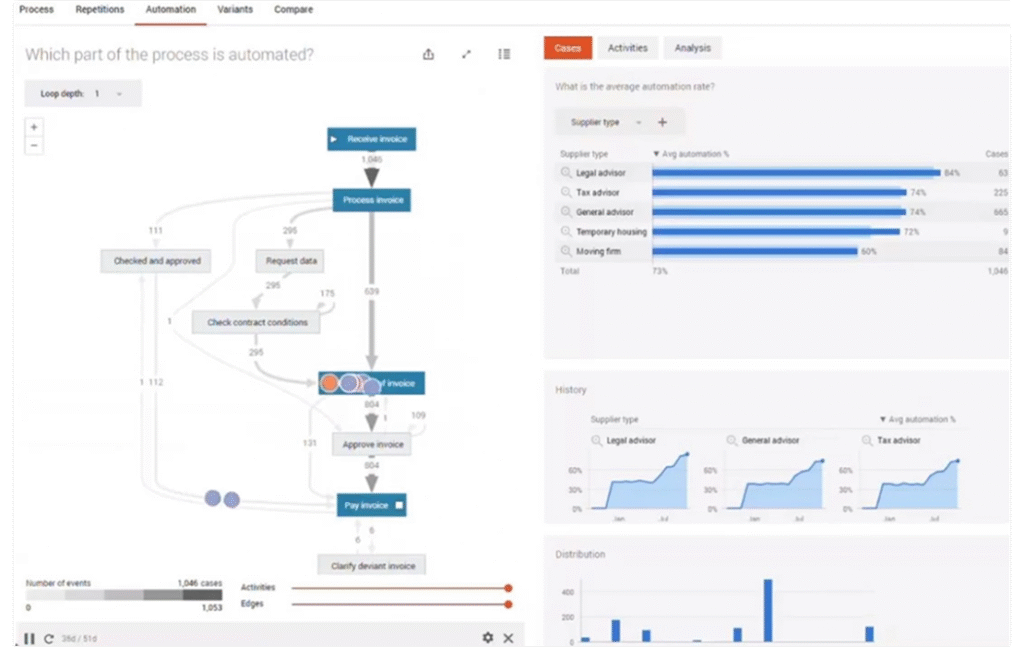
01 How does process mining work? Event logs show how work actually flows across systems.

When employees interact with different systems and applications, they leave traces of activity in data called event logs.

Process mining uses this data to visualize the real process flow in the organization and reveal delays, variants, and hidden inefficiencies.

  • Case ID: a unique identifier of a case, for example a purchase order number.
  • Event type: information about which process step occurred.
  • Timestamp: the exact time of the event, needed to reconstruct sequence and cycle time.

The process mining platform pulls this data from source systems through connectors and builds process maps, root-cause views, and automation opportunities.

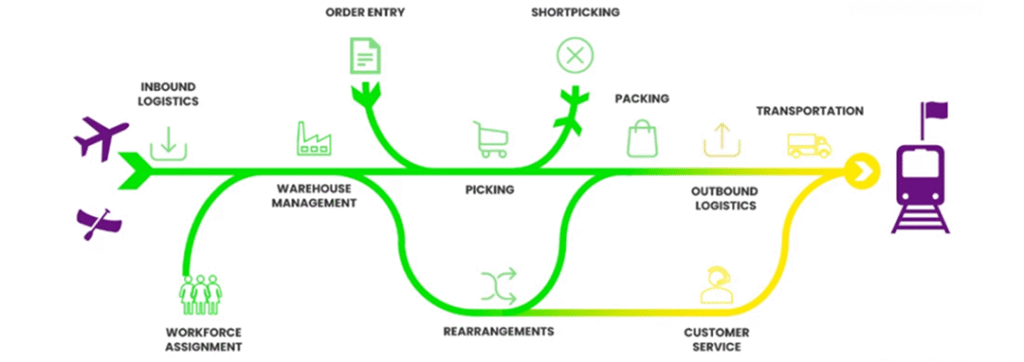
02 What processes in logistics can we improve? From core operations to back-office flows across the value chain.

Process mining supports all key logistics activities in the value chain, including core operations and critical back-office processes.

A common use case is outbound order management, which can be analyzed from multiple business perspectives.

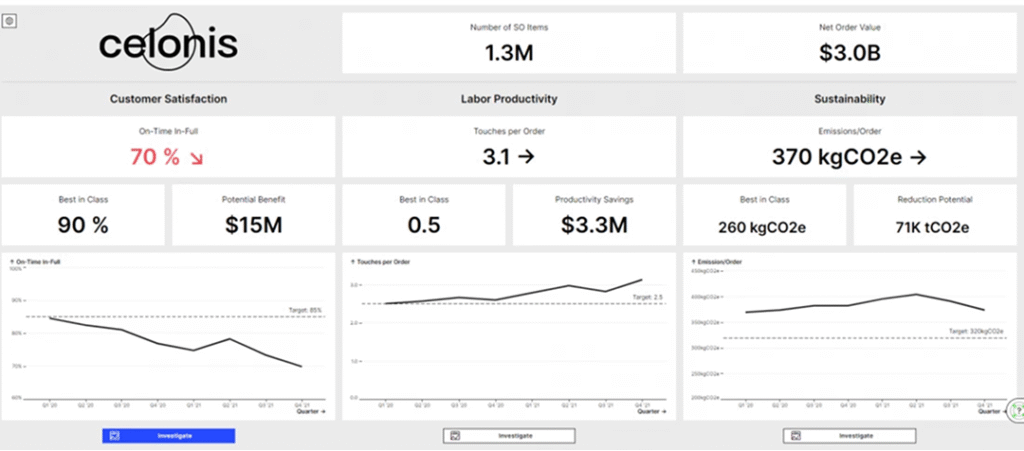
After a one-time data connection, you can immediately switch between productivity, service level, and customer satisfaction views.

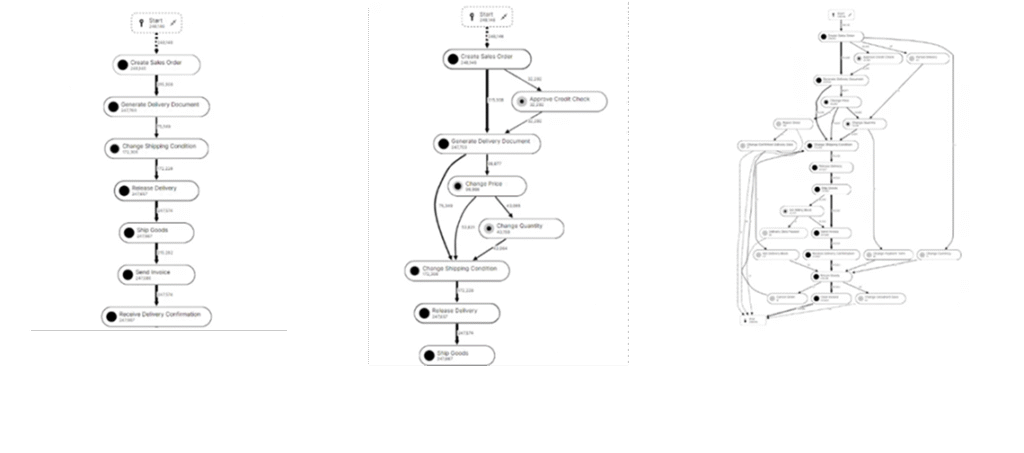
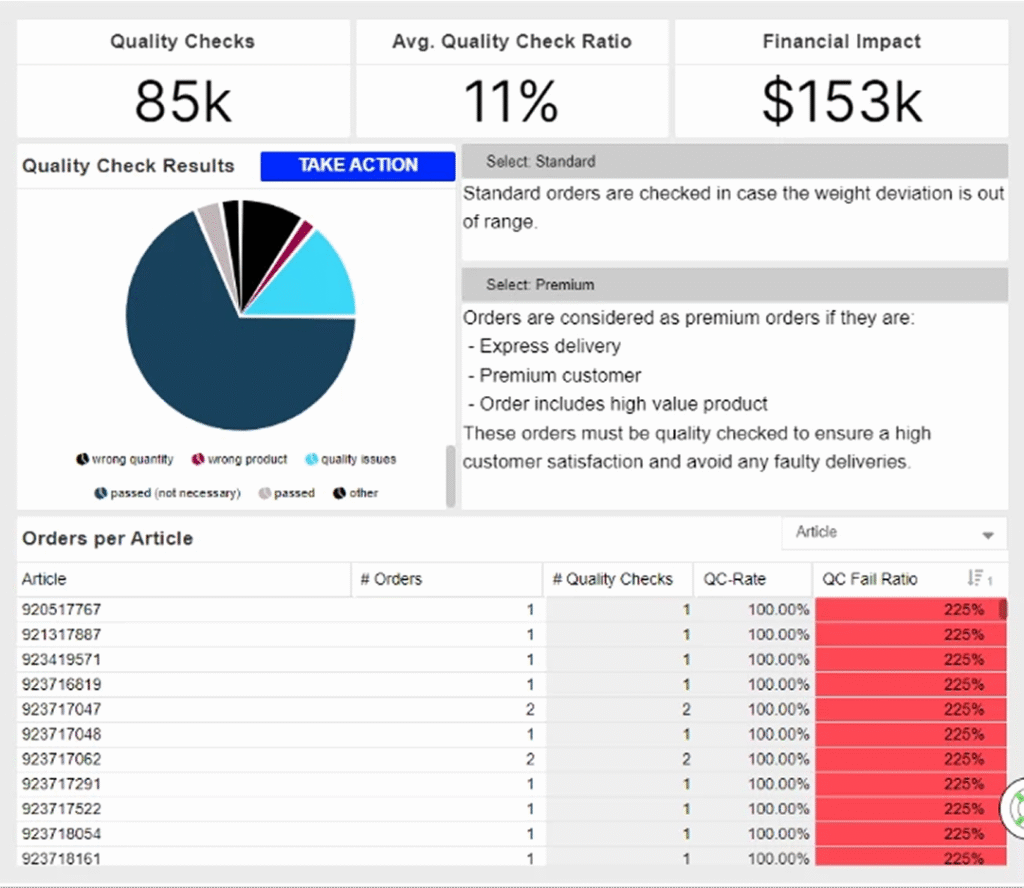
03 Let us take a closer look - First: Understand Your Process Identify all process variants and deviations, including those outside the happy path.

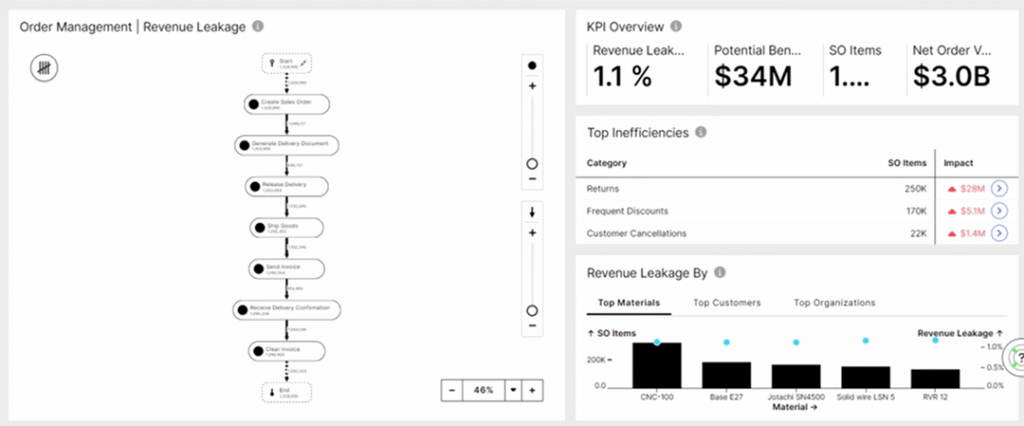
Start with revenue leakage in outbound logistics. Process mining explores process data and shows all existing variants.

From the happy path to unknown violations and deviations, every iteration is visualized and measured.

With full process transparency, teams can pinpoint which activities drive revenue loss and build more resilient process decisions under uncertainty.

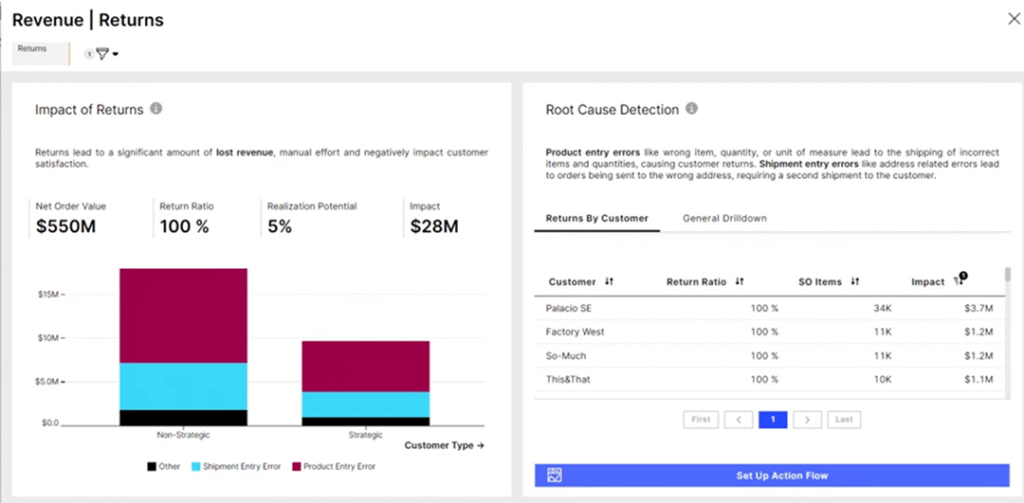
Returns are one of the top inefficiencies in outbound logistics: they add cost and consume time without creating value.

04 Second: Detect Root Cause Measure impact automatically and drill down to source drivers.

The total impact of returns can be measured automatically, and teams can deep-dive through process dimensions to find root causes.

Fast and automated root-cause detection is crucial for reducing returns and improving process quality.

Process mining helps separate returns caused by quality issues, short picks, price changes, or long execution times that drive cancellations.

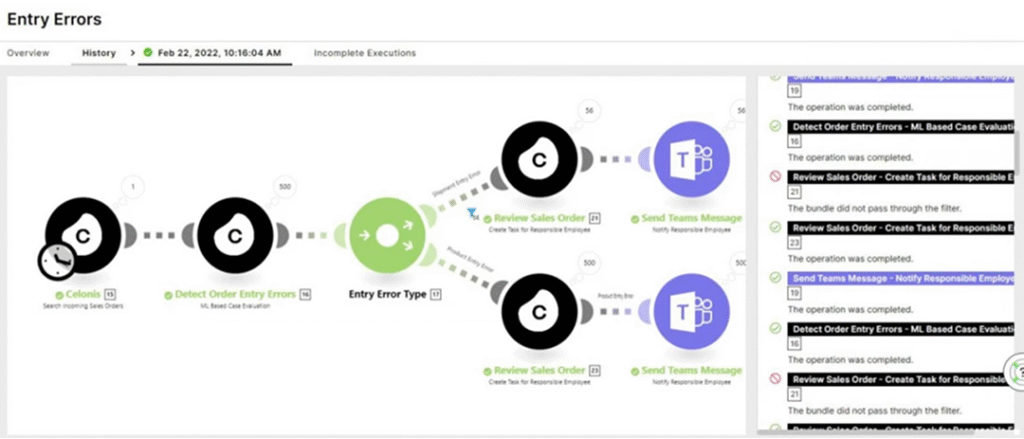
05 Third: Automate What You Cannot Eliminate Remove maximum deviations first, then automate the remaining flow.

Not every inefficiency can be fully eliminated. Process mining supports a sequence: examine the process first, remove major deviations, and then automate.

Automation improves outcomes only when the process is already controlled. Otherwise it can scale the same errors.

If returns cannot be eliminated entirely, process-driven automated workflows still make them less costly and less disruptive for operations.

Let’s build a secure, measurable transformation

Tell us what you’re trying to improve — security posture, compliance readiness, operational efficiency, or automation at scale. We’ll propose a structured next step and a delivery plan.

Automation & Process Mining Partners

We work with leading platforms to deliver a data-driven view of how processes truly run — and turn insights into measurable improvements.

IBM Process Mining

Leverages data mining and process intelligence to deliver actionable insights: performance analysis, bottleneck identification, and validation of improvements. It reconstructs real end-to-end flows across enterprise applications, captures desktop interactions, and maps extracted data into process models for discovery, monitoring, and comparison vs. simulated automation.

IBM Process Mining — Integration & Automation

Integrates with enterprise systems and third-party automation tools. RPA bot generation supports creation of scripts and bot frameworks aligned to your automation stack. Built-in accelerators can automate ETL activities to efficiently extract, transform, and load data from core systems.

IBM Task Mining

Complements process mining by capturing user interaction data to expose manual work and its impact on end-to-end performance. Helps identify best candidates for automation, estimate cost/impact, and validate initiatives before rollout. Continuous monitoring, thresholds, and alerts support operational control and sustained process excellence.

UiPath Process Mining

Part of an ecosystem including Task Mining, Task Capture, and Automation Hub — enabling discovery, evaluation, monitoring and governance across the automation lifecycle. Near real-time insights help accelerate programs, prioritize initiatives, and improve delivery at scale.

Celonis

A global leader in AI-powered process mining and process excellence. Supports discovery, simulation, root-cause analysis, and predictive analytics. Widely adopted in industries such as logistics, financial services, and manufacturing to drive continuous improvement across complex operations.

Unlock Process Efficiency

Use process mining to identify hidden inefficiencies and improvements

Schedule a Consultation